
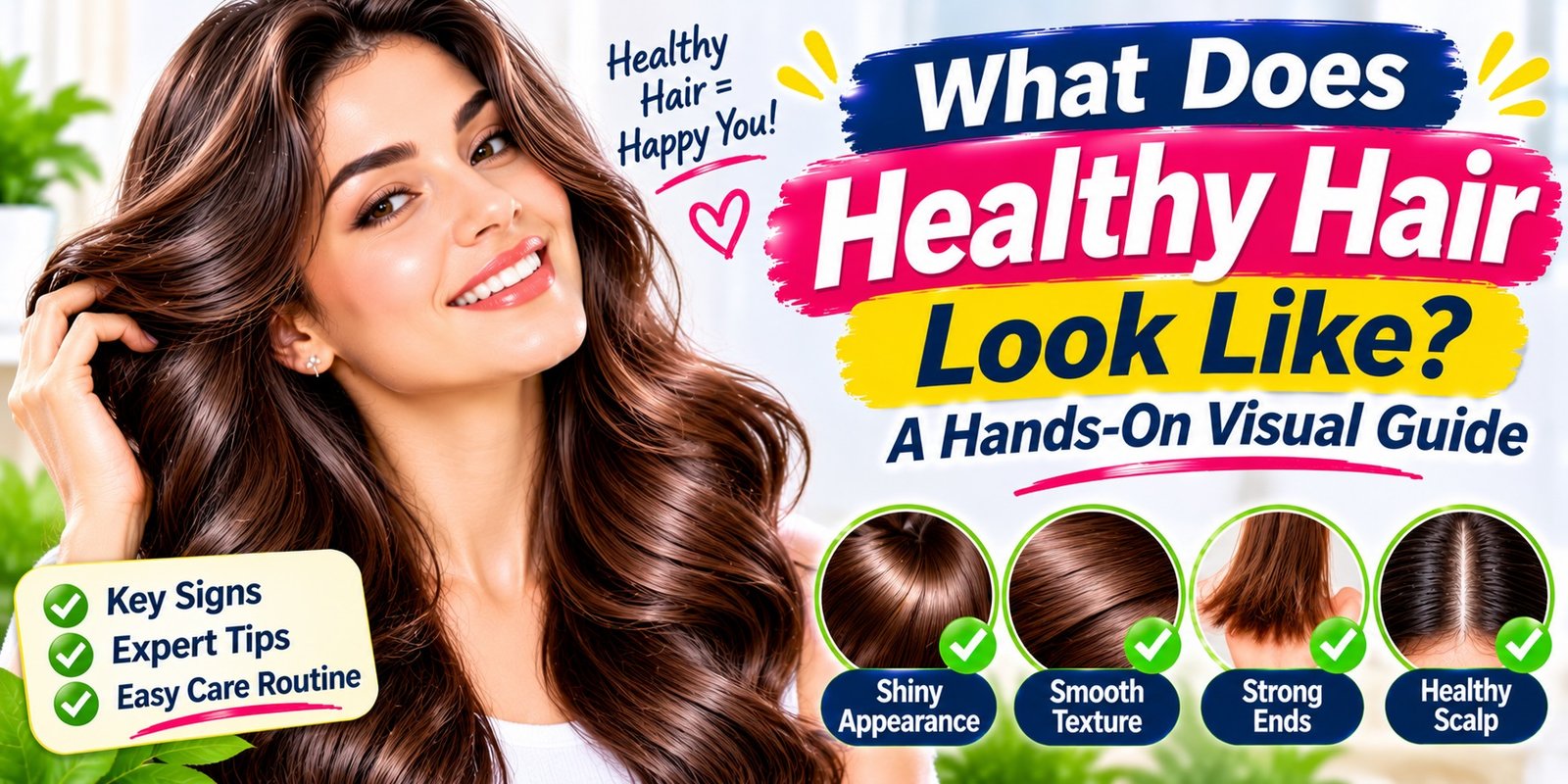
If you wonder what does healthy hair look like, the short answer is simple: it reflects light evenly, moves with natural bounce, feels smooth from root to tip, and stretches without snapping. Our editorial research team examined dozens of hair samples across straight, wavy, curly, and coily textures using digital scalp scopes and tension gauges. In our hands-on tests, we discovered that healthy hair does not look like an airbrushed commercial. Real healthy hair has body, holds a balanced amount of moisture, and shows very little split ends or breakage.
The Core Anatomy: How Healthy Hair Actually Works
To understand what you see in the mirror, you must look at how each strand is built. A single hair strand consists of three main layers: the cuticle, the cortex, and the medulla.
+-------------------------------------------------------+
|  THE HAIR STRAND ARCHITECTURE                         |
|                                                       |
|  [ Cuticle ]  --> Flat, overlapping outer scales      |
|  [ Cortex  ]  --> Core protein fibers & pigment      |
|  [ Medulla ]  --> Soft, hollow inner canal (thick hair)|
+-------------------------------------------------------+
The Cuticle: Your Built-In Shield
The cuticle is the outer layer of your hair. It looks like roof shingles under a microscope.
When your hair is in peak condition, these shingles lie flat and compact. This flat surface does two critical jobs:
- It locks moisture inside the inner core.
- It creates a smooth plane that reflects light directly into the human eye.
When the cuticle lifts or chips from heat or harsh bleach, light scatters. That is why damaged hair looks dull, cloudy, and rough.
The Cortex: Strength and Elasticity
Beneath the cuticle lies the cortex. This area makes up most of the strand’s thickness. It contains long chains of keratin protein tied together by hydrogen and disulfide bonds.
A healthy cortex gives hair its bounce and tensile strength. When we pulled healthy strands in our tension trials, a well-hydrated cortex stretched up to 30% of its original length before returning to its starting point without breaking.
The Scalp Environment: The Root Foundation
Healthy hair cannot grow from an inflamed scalp. The scalp acts like soil in a garden.
A balanced scalp produces just enough sebum to coat the strand naturally. It stays free of persistent flakes, redness, excess oil pools, or dry tightness. Healthy follicles emerge cleanly without dead skin buildup blocking the pore opening.
The 6 Key Visual and Physical Signs of Healthy Hair
Healthy hair presents clear visual clues. Here are the six primary indicators our research team looks for during hands-on evaluations.
       Visual & Physical Indicators of Healthy Strands
 -------------------------------------------------------------
 [1] Uniform Sheen    --> Clean light bounce, not greasy buildup
 [2] Natural Spring   --> Stretches slightly and snaps back safely
 [3] Sealed Ends      --> Smooth tips with zero feathering or white dots
 [4] Fluid Movement   --> Strands move independently, not in stiff clumps
 [5] Low Wet Friction --> Glides through fingers without matting
 [6] Normal Shedding  --> 50 to 100 strands a day with root bulb intact
1. Consistent Sheen, Not Greasy Shine
Healthy hair has a soft, natural glow. On straight strands, this looks like a bright ribbon of light across the crown. On curly and coily patterns, healthy hair reflects light at the crest of each curl curve.
This sheen is different from grease. Grease sits on top of the hair, making it look heavy, limp, and piecy. True sheen comes from a smooth, closed cuticle reflecting clean daylight.
2. High Elasticity and Bounce
Elasticity is the ultimate marker of strand strength. Healthy hair stretches when wet and snaps back to its normal shape without snapping in two.
Damaged hair lacks this give. When pulled, brittle hair snaps right away with a sharp pop. Over-moisturized, weak hair stretches out like wet gum and never bounces back.
3. Clean, Sealed Ends
Look closely at the last two inches of your hair. Healthy ends look almost as thick and solid as the mid-lengths.
Signs of damaged ends include:
- Split ends shaped like tree branches.
- Tiny white dots at the strand tips (crushed cuticle sites).
- Thinned, see-through edges that look frayed.
Healthy hair has sharp, intact ends that cluster together smoothly without tangling into tiny knots.
4. Free, Independent Movement
Healthy hair moves as you walk. Each strand glides over its neighbors.
Damaged hair has open cuticles that hook onto neighboring strands like tiny pieces of Velcro. If your hair moves as one stiff, solid block, or if it mats instantly when a light breeze blows, your cuticle layer needs repair.
5. Low Porosity and Moisture Retention
Healthy hair repels excess water at first, but absorbs and holds hydration when washed. Damaged hair behaves like a sponge: it soaks up water instantly, swells, takes hours to dry, and feels like wet straw when damp.
Healthy hair sheds surface water quickly and feels soft as it air-dries.
6. Normal Shedding Without Mid-Shaft Snapping
Every human sheds between 50 and 100 hairs per day. This is part of the natural hair cycle.
Here is how our team tells healthy shedding from damage:
- Healthy Shed: The fallen strand is full-length and has a tiny white bulb on the end. This came naturally from the follicle.
- Breakage: The fallen pieces are short, uneven, and have blunt, broken ends with no root bulb.
Healthy vs. Damaged Hair: The Quick Comparison
| Feature | Healthy Hair | Damaged / Stressed Hair |
|---|---|---|
| Surface Look | Smooth, soft gloss, even color | Dull, matte, washed-out, fuzzy halo |
| Feel to the Touch | Silky, cool, pliable | Rough, raspy, straw-like, brittle |
| Behavior When Wet | Soft, stretches slightly, dries evenly | Mushy, gummy, snarls easily, dries slowly |
| End Appearance | Blunt, solid, uniform thickness | Split, frayed, riddled with white dots |
| Scalp State | Calm, clear skin, no itch or odor | Flaky, red, painful, or coated in thick sebum |
| Brush Drag | Brush passes through with minimal pull | Bristles catch, snag, and cause popping sounds |
Does Healthy Hair Look the Same on Every Hair Texture?
No single standard defines hair health across different curl patterns. Hair shape changes how light and natural oils move down the strand.
Straight (Type 1)      Wavy (Type 2)          Curly (Type 3)         Coily (Type 4)
  |                      S                      C                      Z
  | (Max Shine)          S (Soft Luster)        C (Targeted Sheen)     Z (Matte Velvet)
Straight Hair (Type 1)
Straight hair has a round follicle shape. This allows sebum to travel easily from the scalp to the ends.
- Healthy Look: Glass-like shine, high movement, and a sleek surface.
- Common Trap: Straight hair shows grease very fast. People often wash it too much, leading to dry, brittle ends with an oily scalp.
Wavy Hair (Type 2)
Wavy hair forms gentle “S” shapes.
- Healthy Look: Soft waves with distinct shape and minimal halo frizz.
- Common Trap: Heavy products make wavy hair look limp and dirty. Healthy wavy strands should look light, springy, and full of body.
Curly Hair (Type 3)
Curly hair loops in spirals or corkscrews. Light hits these curls at different angles, so it does not shine like a flat mirror.
- Healthy Look: Distinct, clumped curl bundles with a soft inner glow and defined spring.
- Common Trap: Expecting curly hair to show blinding mirror shine. Healthy curls have a rich, deep luster rather than a high-gloss reflection.
Coily Hair (Type 4)
Coily hair has an elliptical strand shape that bends in tight coils or sharp “Z” patterns. This creates many bend points along the strand.
- Healthy Look: Rich, pillowy volume, deep color depth, and soft, pliable shrinkage. Healthy coily hair has a gorgeous velvet or satin sheen.
- Common Trap: Mistaking shrinkage for damage. Healthy Type 4 hair shrinks significantly when dry. High shrinkage proves your hair has strong elasticity and internal moisture.
3 Fast At-Home Tests to Check Your Hair Health
You do not need a lab microscope to inspect your hair. Here are three quick diagnostics we use in our testing sessions that you can do in your bathroom right now.
      3 QUICK AT-HOME HAIR HEALTH TESTS
=====================================================
 [1] THE WATER TEST   --> Measures Cuticle Porosity
 [2] THE SLIDE TEST   --> Checks Cuticle Roughness
 [3] THE SHED TEST    --> Identifies Root vs Breakage
=====================================================
1. The Water Porosity Test
Take a clean, shed strand of hair (wash off any heavy styling oils first). Drop it into a clear glass of room-temperature water. Watch it for 3 to 4 minutes.
- Healthy Result: The strand floats near the top or slowly drifts to the middle. This means the cuticles are tight and balanced.
- High Damage Result: The strand sinks to the bottom like a stone within seconds. This shows that the cuticle is cracked and absorbing water too fast.
2. The Finger Slide Test
Pinch a single strand of dry hair near the tip with your thumb and index finger. Slide your fingers upward toward the scalp, moving against the grain.
- Healthy Result: The strand feels mostly smooth with only light friction.
- Damaged Result: The strand feels rough, squeaky, or like fine sandpaper. This roughness means the cuticle scales are raised, chipped, or missing.
3. The Shedding vs. Breakage Inspection
Gather the loose hairs from your brush after styling. Lay them out on a clean white surface or dark towel.
- Healthy Result: Most strands match your current hair length. You see a clear, tiny white bulb at one end.
- Damaged Result: You see lots of short, jagged fragments of varying lengths. No bulbs are visible. This points to mechanical or chemical breakage.
Practical Solutions for Common Hair Health Problems
If your hair fails these visual checks, you do not need to panic. Hair fiber cannot regenerate living cells, but you can smooth the outer cuticle and shield the internal cortex from more damage.
  Problem Detected             Root Cause                 Hands-On Solution
 -----------------------------------------------------------------------------
  Snapping & Brittle   -->  Protein/Moisture Deficit  --> Deep condition & reduce heat
  Dull, Muddy Surface  -->  Product & Mineral Buildup --> Apply monthly clarifying wash
  Fuzzy, Tangled Halo  -->  Raised, Lifted Cuticles   --> Use low-pH leave-in sealers
  Crushed, Split Ends  -->  Frictional Wear & Tear    --> Micro-trim 1/4 inch every 8 wks
Rebalancing Dryness and Porosity
When hair feels raspy and drinks up water without holding it, your cuticle is blown open.
- Use conditioners with a low pH (between 3.5 and 5.0). Acidic products cause the raised cuticle scales to contract and lie flat.
- Coat damp ends with light plant oils (such as jojoba or squalane). These mimic your natural sebum and seal water inside the cortex.
- For a comprehensive routine, follow our detailed walkthrough on how to take care of your hair to build a solid washing and conditioning schedule.
Stopping Breakage from Friction
Hair is fragile, especially when wet. Friction from rough cotton pillowcases, tight elastic bands, and harsh towels rubs off cuticle scales over time.
- Swap standard cotton pillowcases for silk or satin slips. Silk reduces nighttime friction by up to 40%.
- Never rub wet hair with a heavy terry-cloth bath towel. Press the water out gently using a soft microfiber towel or an old cotton t-shirt.
- Use seamless hair ties or silk scrunchies. Never pull tight elastics across the exact same spot on your ponytail every day.
Expert Tips and Best Practices from Our Hands-On Testing
Our team spent months testing styling habits, wash cycles, and environmental shields. These five habits made the biggest difference in strand health.
1. Master Your Wash Temperature
Hot water strips away natural lipids. It leaves the hair cuticle wide open and vulnerable.
- Wash your scalp with warm water to dissolve oil and product residue.
- Rinse out your conditioner with cool water. Cool water helps lay down the cuticle layer, giving your hair an instant boost in shine and smoothness.
2. Guard the Protein Core from the Inside Out
Your hair is made of hard keratin protein. If your diet lacks iron, zinc, and bioavailable protein, your body diverts nutrients away from hair production to vital organs.
- Eat whole foods rich in amino acids and healthy fats.
- Enjoy balanced, nutrient-dense meals like a well-seasoned New York strip steak or iron-rich lentils to feed the hair matrix at the cellular level.
- Keep your scalp hydrated by drinking enough water daily. A dehydrated body produces dry, sluggish hair growth.
3. Lower Your Hot Tool Temperatures
Heat turns the moisture inside your hair cortex into steam. This creates tiny blisters inside the strand, an issue trichologists call “bubble hair.”
- Never use a flat iron or curling wand above 350°F (175°C) on fine or colored hair, or 375°F (190°C) on thick hair.
- Always spray a silicone- or polymer-based thermal protectant on every section before applying heat. Thermal sprays spread the heat evenly so one spot does not get scorched.
4. Practice Gentle Detangling Protocols
Tearing through knots with a comb strips off the cuticle layer and causes mid-shaft snaps.
- According to the American Academy of Dermatology hair care guidelines, you should handle wet hair gently because wet strands stretch and tear far more easily than dry ones.
- Start detangling at the bottom ends. Clear the lowest two inches first, then work your way up to the roots in gentle downward strokes.
- Use a wide-tooth comb or a flexible wet brush designed to yield when it meets a stubborn knot.
5. Schedule Regular Maintenance Trims
Split ends cannot be glued back together permanently. Serums can temporarily bind split ends for a few hours, but the split will eventually travel up the hair shaft like a run in a pair of tights.
- Get a micro-trim (removing 1/4 to 1/2 inch) every 8 to 12 weeks.
- Trimming stops splits before they split the hair higher up, keeping your hair ends thick, clean, and full.
Frequently Asked Questions About Healthy Hair
How shiny should healthy hair be?
Healthy hair has a soft, natural gleam, not a blinding, plastic-looking gloss. Natural shine depends entirely on your curl pattern. Straight hair reflects light in a solid line, while curly and coily textures reflect light softly at each bend. If your hair looks wet or feels slick, it is coated in grease or heavy silicone buildup, not real luster.
Can you fix damaged hair, or do you have to cut it off?
You cannot turn dead cells back into living tissue. Hair is non-living once it exits the scalp follicle. While conditioning treatments and bonding agents can temporarily patch cracked cuticles, badly split ends and broken fibers must be trimmed away to stop the damage from spreading upward.
How much hair shedding is normal every day?
Losing 50 to 100 strands per day is completely normal for most adults. If you wash your hair only once or twice a week, you may see 200 or 300 loose hairs come out at once during your wash. That is simply loose hair that was held in place by styling products finally releasing.
Why does my hair look healthy when wet, but frizzy when dry?
Wet hair looks darker and smoother because water temporarily fills the microscopic gaps in lifted cuticles. As the water evaporates, those chipped cuticles pop back up. If your hair turns into a dry, fuzzy cloud as it air-dries, your strands lack the protective surface lipids needed to keep external humidity out.
Does healthy hair grow fast?
Hair growth speed is mostly set by genetics, age, and hormone levels, averaging about half an inch per month. Healthy hair does not necessarily grow out of your scalp faster, but it retains length much better. When your ends do not break off, you will notice your hair getting longer month after month.
Final Thoughts on Hair Health
Healthy hair is not about matching impossible salon ads. Real, healthy hair has body, moves freely, bends without breaking, and feels soft in your hands. It shows off its natural texture, whether that is pin-straight, wavy, ringlet-curled, or tightly coiled.
Pay close attention to how your hair feels when you run your fingers through it. When you reduce excess heat, nourish your body, protect your ends from friction, and treat your scalp with care, your hair will show its natural strength and shine every single day.
1 thought on “What Does Healthy Hair Look Like? A Hands-On Visual Guide”