
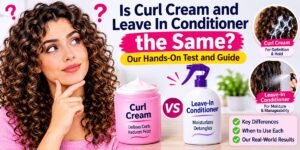
If you wonder whether is curl cream and leave in conditioner the same, the short answer is no. While both bottles sit side by side in the hair aisle, they do completely different jobs on your hair. Our editorial research team tested both products across different curl types to see how they perform in real life. What we discovered is that one product hydrates the hair shaft, while the other styles and shapes the outer curl. In this guide, we break down what each formula does, why the order of use matters, and how to get your best hair day yet.
What Is a Leave-In Conditioner?
A leave-in conditioner is a lightweight treatment designed to add moisture and improve manageability. Think of it as a tall glass of water for thirsty hair. Standard rinse-out conditioners coat your strands in the shower and get washed down the drain. A leave-in stays on your strands until your next wash day.
During our hands-on tests, we noticed that leave-in formulas tend to be watery, milky, or lightly creamy. They focus on internal hydration rather than hold.
[ Water & Humectants ] ---> Absorbs into the hair cortex ---> Softens & detangles
Key Jobs of a Leave-In Conditioner:
- Detangling: It adds slip so your wide-tooth comb glides through wet knots without snapping strands.
- Hydration: It pulls water into dry hair cuticles using humectants like glycerin, aloe vera, and panthenol.
- Protection: It creates a light barrier against daily friction, heat, and environmental dry air.
- Softening: It smooths rough hair scales, leaving hair soft to the touch.
If you struggle with parched strands, knowing how to keep your hair moisturized starts with choosing a good leave-in product right after washing.
What Is a Curl Cream?
A curl cream is a styling product designed to enhance shape, clump strands together, and reduce surface frizz. If a leave-in conditioner is water, a curl cream is the sealant and sculptor.
Curl creams are thicker, richer, and contain film-forming ingredients. These ingredients wrap around individual curl clumps. When we applied curl cream to wet curls during our testing sessions, we saw loose, scattered hairs immediately pull together into defined spirals.
[ Oils, Butters & Polymers ] ---> Coats the outer cuticle ---> Clumps curls & locks out frizz
Key Jobs of a Curl Cream:
- Curl Definition: It encourages natural wave and curl patterns to group together.
- Frizz Control: It seals the outer cuticle layer so humid air cannot cause flyaways.
- Light to Medium Hold: It gives curls a soft, touchable hold without the hard crunch of a traditional gel.
- Moisture Retention: Heavy emollients like shea butter, argan oil, and jojoba oil seal moisture inside the strand.
Direct Comparison: Leave-In Conditioner vs. Curl Cream
To show why these two products are not interchangeable, here is a quick look at how they stack up side by side.
| Feature | Leave-In Conditioner | Curl Cream |
|---|---|---|
| Primary Goal | Hydrate, detangle, and soften | Define, shape, and smooth curls |
| Main Ingredients | Water, aloe vera, glycerin, light oils | Plant butters, heavy oils, styling polymers |
| Texture | Runny liquid, fine mist, or light lotion | Thick cream, paste, or rich butter |
| Level of Hold | Zero hold | Light to flexible hold |
| Best Applied To | Soaking wet or damp hair | Wet or damp hair after leave-in |
| Hair Types | All hair types (straight, wavy, curly, coily) | Textured hair (waves, curls, and coils) |
Why They Are Not the Same Product
The common confusion comes from the fact that both products leave hair feeling soft. Many curl creams contain moisturizing oils, and many leave-ins contain smoothing agents. However, their core chemistry serves two separate phases of hair care: conditioning and styling.
1. The Formulation Difference
Leave-in conditioners rely on low-molecular-weight ingredients. These tiny molecules slip past the cuticle layer into the inner cortex.
Curl creams rely on higher-molecular-weight ingredients. These larger molecules sit on top of the cuticle. They coat the strand to create tension and grip, which helps your natural curl spring up.
2. The Hold Factor
If you use only a leave-in conditioner, your hair will feel soft, but your curls may quickly fall flat or turn into a cloud of frizz as the day goes on. Leave-in conditioner has no hold.
A curl cream contains styling polymers or natural resins that hold the curl pattern in place. It gives you shape that lasts through work, workouts, and sleep.
Can You Use One Instead of the Other?
We tested what happens when you substitute one for the other. Here is what we found on various hair textures:
What Happens If You Only Use Leave-In Conditioner?
- The Result: Hair feels soft, clean, and airy.
- The Downside: Within a few hours of drying, curls lose their shape. Frizz appears quickly because there are no film-forming polymers to lock the strands together.
- Who Can Get Away With It: People with very fine, wavy hair who get weighed down by heavy creams.
What Happens If You Only Use Curl Cream?
- The Result: Curls look defined, glossy, and shaped right after styling.
- The Downside: Over time, hair can become dry and brittle underneath. Curl cream coats the hair, but without a hydrating base, that outer coating can trap dryness inside.
- Who Can Get Away With It: People with thick, coarse hair that already has balanced moisture levels from a deep conditioning mask.
How to Layer Both Products (The Proper Routine)
For most curl types, you do not have to choose between them. Using them together gives you the benefits of both moisture and shape. In our trials, following a simple layering sequence produced the longest-lasting definition.
[ Shampoo & Rinse ]
       │
       ▼
[ Step 1: Leave-In Conditioner ]  ──► (Hydrates & Detangles)
       │
       ▼
[ Step 2: Curl Cream ]           ──► (Shapes & Defines)
       │
       ▼
[ Step 3: Gel or Mousse ]        ──► (Optional: Locks in Hold)
Step 1: Start on Clean, Wet Hair
Apply your products while your hair is still damp or wet from the shower. Water is the true source of hydration. Your products are there to catch that water and keep it inside the hair fiber.
Step 2: Rake Through Your Leave-In Conditioner
Take a quarter-sized amount of leave-in conditioner (or a few spritzes if using a spray). Work it from your mid-lengths down to your ends. Use your fingers or a brush to detangle. When learning how to choose the right formula, always match the weight of the conditioner to your hair thickness so you do not lose volume.
Step 3: Smooth and Scrunch Your Curl Cream
Once your hair is hydrated and detangled, rub a dime- to nickel-sized amount of curl cream between your palms. Smooth it over your hair using the “praying hands” method, then gently scrunch upward toward your scalp. This encourages your curls to form their natural shape.
Step 4: Dry Gently
Let your hair air dry, or attach a diffuser to your blow dryer on low heat. Avoid touching your curls while they dry, as friction breaks up curl clumps and creates halo frizz.
Tailoring Your Choice to Your Hair Type
Not every curl pattern needs the exact same balance of moisture and hold. Here is how our team adjusted product usage across different textures:
Type 2: Wavy Hair
Wavy hair has a gentle S-shape that gets weighed down easily.
- Our Recommendation: Use a lightweight, spray-based leave-in conditioner. Follow with a pea-sized amount of curl cream or swap the cream for a lightweight mousse. Heavy butters will stretch your waves into flat lines.
Type 3: Curly Hair
Curly hair ranges from loose loops to tight corkscrews. It needs a true balance of water and oil.
- Our Recommendation: Use both products. Apply a milky leave-in conditioner first, followed by a medium-weight curl cream. This combination keeps spirals bouncy, glossy, and springy all day.
Type 4: Coily and Kinky Hair
Coily hair has tight zig-zag or spiral patterns and naturally loses moisture faster than any other hair type.
- Our Recommendation: A thick, rich leave-in conditioner followed by a dense, butter-rich curl cream is essential. The leave-in provides the deep hydration, while the thick cream seals the cuticle and prevents moisture from escaping.
Common Mistakes to Avoid
Through our testing and research, we spotted several common pitfalls that leave curls greasy, limp, or parched:
- Applying to Dry Hair: Putting leave-in conditioner or curl cream on bone-dry hair often results in product sitting on the surface, creating a chalky, greasy film. Always apply to damp or wet strands.
- Using Too Much Product at Once: Start with less than you think you need. You can always add more, but washing out excess cream requires starting your wash day over.
- Applying Directly to the Roots: Keep both leave-ins and curl creams at least two inches away from your scalp. Applying heavy oils to your roots clogs follicles and makes hair look flat.
- Skipping Clarifying Washes: Because curl creams contain butters and waxes, they build up on the hair shaft over time. Use a gentle clarifying shampoo every few weeks to reset your hair canvas.
Expert Tips and Best Practices
To get the most out of your styling routine, keep these field-tested tips in mind:
- Check the Porosity of Your Hair: Low-porosity hair struggles to absorb thick creams, while high-porosity hair drinks them up instantly. If your hair takes hours to dry, stick to lightweight leave-in sprays and lighter styling lotions.
- Consult Styling Science: As noted in this detailed hair texture and formulation guide, layering products from thinnest to thickest consistency ensures that water-based hydrators penetrate before oil-based sealants block them out.
- Emulsify Before Applying: Always rub creams between your palms with a splash of water until the product turns clear or milky before touching your hair. This spreads the formula evenly and prevents clumps of cream in one spot.
- Use Water as a Styling Tool: If your curl cream feels sticky as you apply it, spritz your hair with warm water instead of adding more cream. Water reactivates the product and smooths out the texture.
Frequently Asked Questions
Do I apply curl cream or leave-in conditioner first?
Always apply leave-in conditioner first, followed by curl cream. The leave-in conditioner penetrates the hair to deliver moisture, while the curl cream seals that moisture in and shapes your curls.
Can curl cream replace a leave-in conditioner?
For very coarse, thick hair, some rich curl creams have enough moisturizing oils to act as a stand-alone product. However, for most hair types, skipping leave-in conditioner leads to dry hair over time because curl creams lack deep-penetrating hydrators.
Will leave-in conditioner make straight hair curly?
No, neither leave-in conditioner nor curl cream will create curls in naturally straight hair. Curl creams work by supporting and defining your natural pattern, not by changing the physical structure of your hair follicle.
Can I use curl cream every day?
It is best not to apply curl cream every single day, as layering thick butters without washing leads to heavy buildup. Instead, refresh second-day curls with a light mist of water or a diluted leave-in spray to reactivate the cream already in your hair.
Does curl cream leave a crunchy cast?
Unlike strong-hold gels, quality curl creams leave hair soft, touchable, and flexible. If your hair feels stiff or crunchy, your product may contain drying styling polymers, or you may be using too much formula for your hair density.
Final Thoughts
While both products live in the same section of your bathroom cabinet, curl cream and leave-in conditioner are distinct tools with different purposes. Leave-in conditioner is your foundation for hydration, slip, and health. Curl cream is your architect for definition, clump formation, and frizz defense.
When you use them in harmony—applying your hydrating leave-in first and sealing with your curl cream second—you give your curls the exact balance of moisture and control they need to thrive. Start with small amounts, listen to how your hair responds, and enjoy soft, defined curls that last.
3 thoughts on “Is Curl Cream and Leave In Conditioner the Same? Our Hands-On Test and Guide”